
Frontieras Is Building a Headquarters in the Energy Capital of the World
And how Houston got that name in the first place.
By Frontieras North America
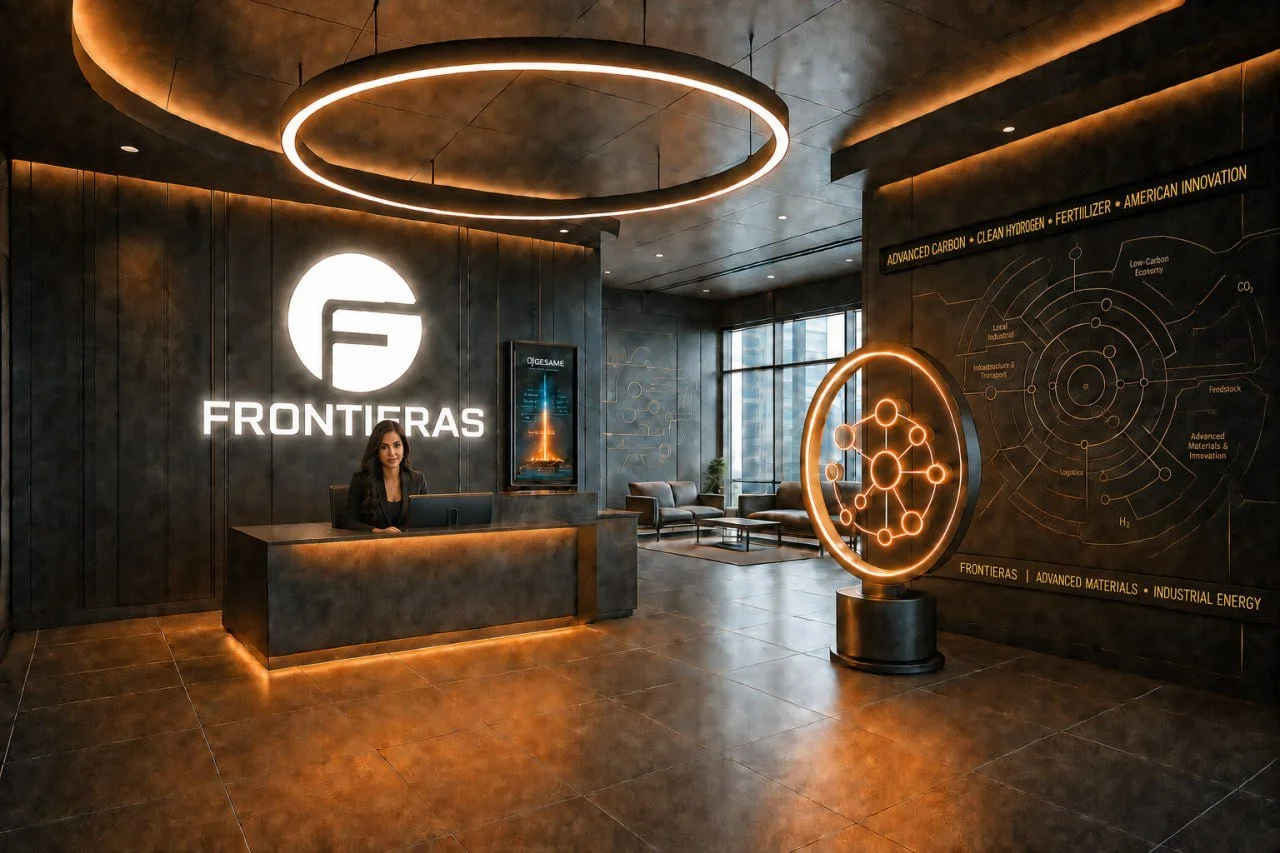
Design concepts for our Houston headquarters. Final buildout may vary.
Frontieras North America is building its corporate headquarters in Houston, in Energy Tower IV in the Energy Corridor, with a grand opening later this year.
Capital, engineering talent, offtake desks, EPC firms, and the people who finance and build the world's largest energy projects all converge in the same few square miles. If you are serious about energy at industrial scale, that city is where the decisions get made, and you either have a place there or don’t. Frontieras now has one. Our space is being built for the conversations that decide things—diligence, offtake, engineering, and the long-horizon capital that funds industrial infrastructure. These are the kinds of meetings that need to happen across a table instead of a screen.
Here is the part most people never think about: there is no oil under Houston. There's no coal either. The city known as the energy capital of the world is not sitting on top of anything, and it never was.
That’s the most interesting thing about Houston, and it’s why we’re going there.
We Don't Mine Coal. We Take It Apart.
Coal companies typically headquarter near the seam, because their business is getting the resource out of the ground and onto a train. But that’s never been our business.
Frontieras commercializes FASForm™ Solid Carbon Fractionation, a patented process that disassembles coal rather than burns it. Coal enters a single-stage, oxygen-deficient reactor, and what comes out the other side is six separate revenue streams: diesel, naphtha, jet fuel, FASCarbon™, ammonium sulfate fertilizer, and sulfuric acid. The technology is protected by patents granted in nine countries across five continents, covering roughly 84% of global coal reserves and 91% of global production. Coal’s value was always locked inside the rock; the industry simply never had a way to get at it without setting it on fire first.
That makes Frontieras a hydrocarbon processing company whose feedstock happens to be coal. And processing companies live in Houston, next to the engineers who design their facilities, the firms that build and operate them, and the desks that buy what comes out.
The first FASForm™ facility is under construction in Mason County, West Virginia, but it won't be the last. The plants go where the coal is, and the headquarters goes where the decisions get made.
"Houston is the capital of global energy, and a company built to change how the world uses its most abundant hydrocarbon resource belongs here. When we open our doors, we're not visiting the energy community—we're part of it."
— Matthew McKean, Chairman, CEO, and Co-Founder
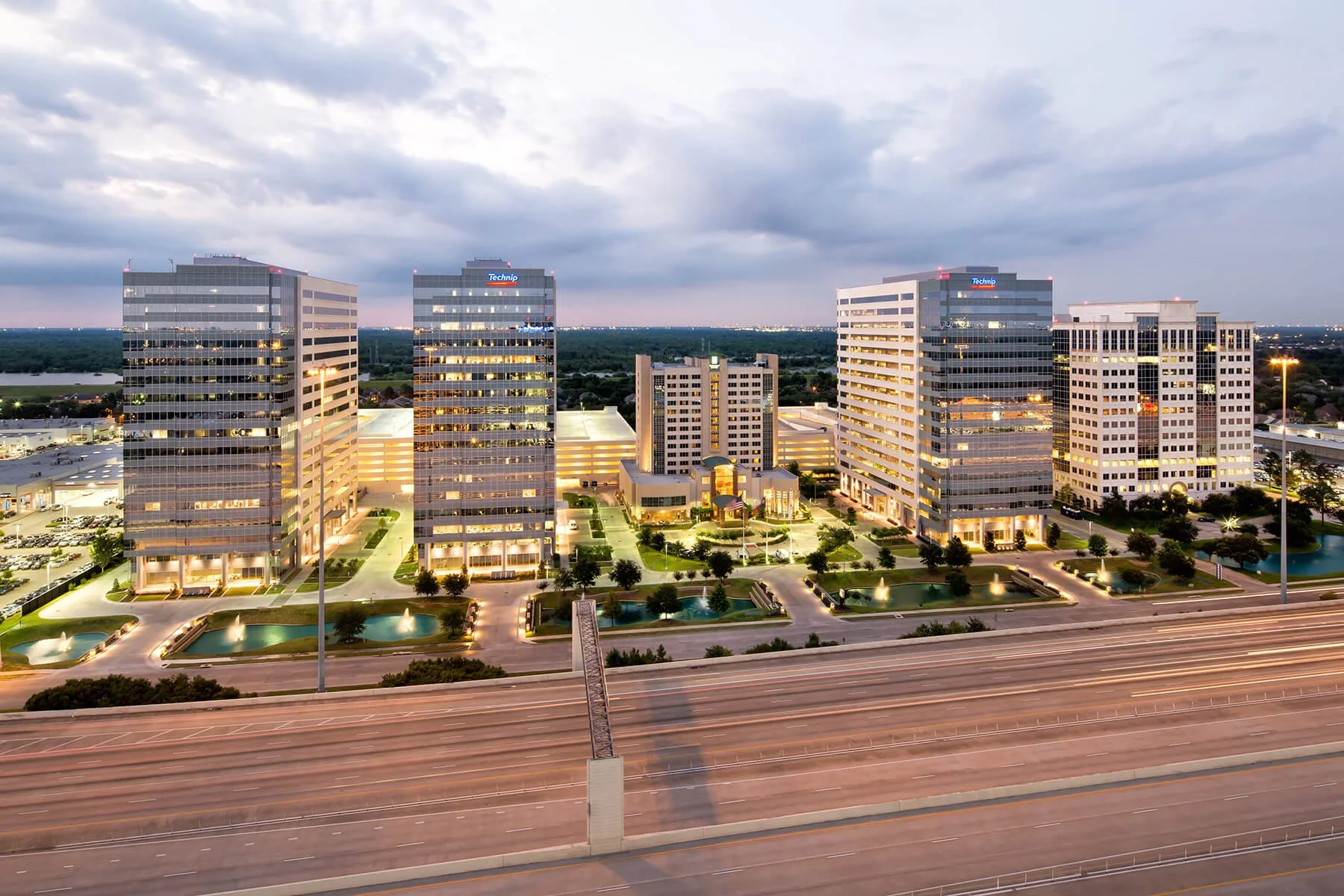
Energy Tower IV in the Energy Corridor
The Office Is the Technology, Told in Architecture
Walk in and the first thing you’ll see is the halo—an illuminated ring suspended above the reception floor that echoes the geometry of the FASForm™ reactor and the mark at the center of our logo. On the wall, the process itself is drawn in light: feedstock in, six products out. Across from it, in bold letters you can read from the elevator, the promise the whole company is built on: Abundant. Affordable. Available.
The palette is deliberately dark and warm, with walnut, charcoal, brushed metal, and amber. It is not climate-tech pastel, and it is not a coal company's dusty back office. It reads the way the company reads: industrial, confident, and unapologetic.
This office will be where strategic partners, engineering firms, offtakers, and institutional investors will go to meet the team, changing how the world gets value out of coal.
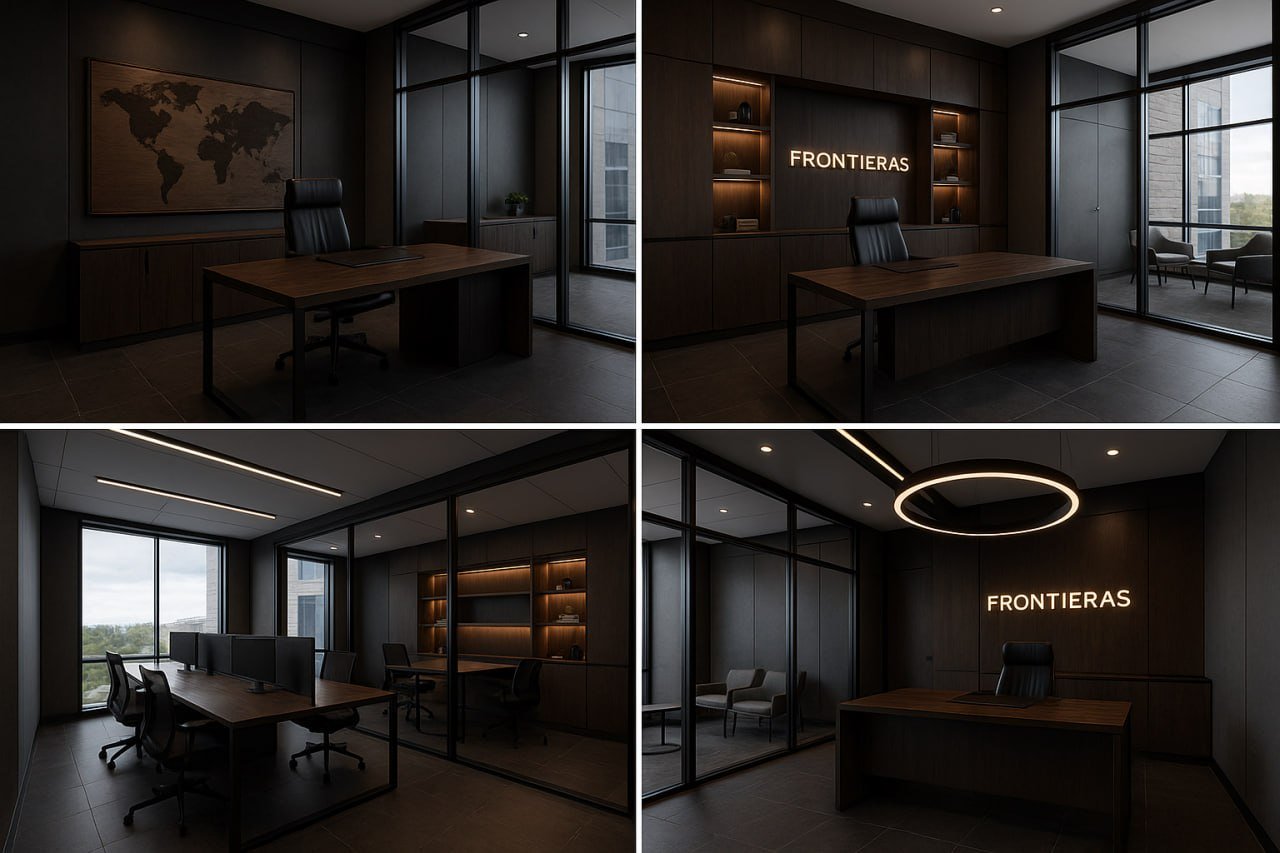
More design concepts for our Houston headquarters. Final buildout may vary.
How Houston Got Its Nickname
Which brings us back to the strange fact underneath all of this. Houston has no oil, and it never did.
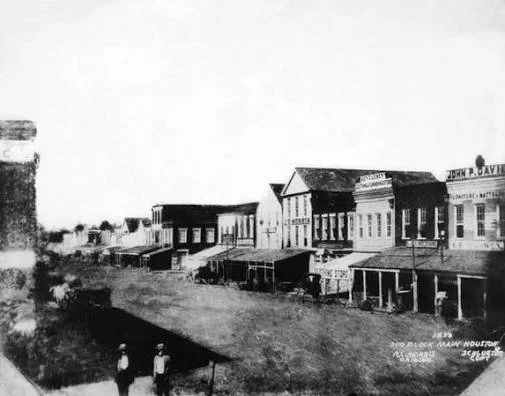
Two brothers founded Houston in 1836 on a bend of Buffalo Bayou, at the last point a boat could reach, and for the next sixty years that was roughly the extent of its advantage. The American Society of Civil Engineers describes the original waterway as swampy, marshy, and choked with vegetation, passable by shallow-draft boats and nothing larger. Galveston, fifty miles downstream, had the actual harbor. Houston had cotton, mud, and a few hundred people.
Then four months in 1900 and 1901 changed everything.
September 1900. A hurricane struck Galveston and killed somewhere between 6,000 and 12,000 people, still the deadliest natural disaster in American history. The region's deepwater port, thought to be its strength, proved to be its biggest vulnerability. The argument for a harbor somewhere inland, upstream, and behind cover no longer had to be made.
January 1901. A well came in at a salt dome outside Beaumont, ninety miles east. It threw oil more than a hundred feet in the air at a rate of roughly 100,000 barrels a day and ran for nine days before anyone could cap it. Spindletop turned Texas into an oil state overnight, its own liquid gold rush, and within months hundreds of companies had formed to chase it. Houston had none of the oil. What it had was the nearest set of rail connections, warehouses, and wharves to a boom that suddenly needed all three.
1908–1914. The Texas Company—later Texaco—moved its general offices from Beaumont to Houston in 1908, and other firms followed, but the constraint was still the bayou. In 1909, Harris County formed a navigation district and issued bonds to cover half the cost of dredging a deepwater channel; Congress matched the rest. Crews spent two years cutting fifty miles of channel through bayou and bay. The work finished on September 7, 1914, and on November 10 the Houston Ship Channel opened to ocean-going vessels at twenty-five feet deep.
1919–1930. Almost nothing stood on the channel's banks when it opened. Humble Oil & Refining sold half its stock to Standard Oil of New Jersey to finance a refinery, broke ground in the fall of 1919, and ran the first oil into a still on May 11, 1920. That site still operates today as ExxonMobil's Baytown complex. By 1930 eight refiners had been built along the channel. Engineers followed the refiners, capital followed the engineers, and the trading desks followed the capital.
A century later, the concentration is hard to overstate. ExxonMobil, Chevron, Phillips 66, ConocoPhillips, Occidental, Halliburton, Baker Hughes, Kinder Morgan, and Cheniere are all headquartered in the Houston area, part of twenty-seven Fortune 500 companies based there, tied with Chicago for second in the country behind only New York. The Greater Houston Partnership counts roughly 4,200 energy-related firms across the region, and the Energy Corridor, a seven-mile stretch of Interstate 10 on the west side of the city, holds more corporate energy offices than any comparable district on earth. The capital that funds energy infrastructure at scale is concentrated in a few square miles, and it does not travel well.
None of this was geology or guaranteed to happen. Houston became the energy capital of the world because it decided to be one and dug fifty miles of channel to make it true.
The oil is still somewhere else, but the decisions are in Houston.
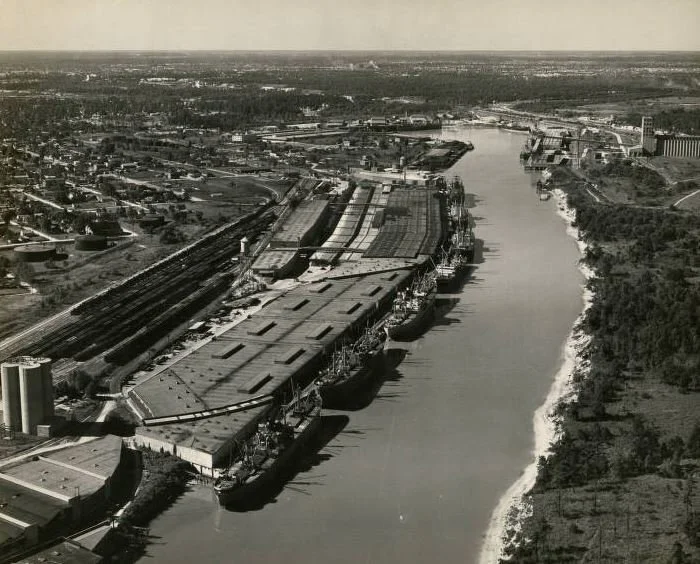
Houston Ship Channel, 1946. Courtesy of the University of Houston.
Where You Dig and Where You Decide
Houston has been running on that split since 1901. The oil came out of the ground ninety miles east; the decisions about it were made here.
Frontieras is built the same way. Our facilities go where the coal is—the first is in West Virginia, and there will be others. Houston is where the decisions about all of them will get made. Where an offtake conversation gets finished. Where a sovereign or institutional investor sits down for diligence. Where the firms that engineer, construct, and operate our plants are a short drive away instead of a flight.
One headquarters. Many plants. Most of the coal sector only ever had the plants. Plenty of energy companies only ever had the first. The businesses that actually build things have both.
There is still no oil under Houston, but that was never the point.
Matt McKean will host an investor webinar on Wednesday, August 5 at 12:00 PM ET covering our current offering and where the company is headed, followed by live questions. [Register here.]