Frontieras and the Diesel Crisis: New Refining Capacity Outside the Chokepoints
Diesel is at a record premium over crude. The shortage isn't oil. It's refining, and FASForm™ adds supply from a feedstock that never crosses a strait.
The premium ultra-low sulfur diesel commands over crude oil hit a record. In mid-September, the US diesel crack spread topped $117 a barrel. A month earlier, it had crossed $100 for the first time in history.
Read those numbers carefully, because they say something the headlines keep missing. A crack spread is the price of turning crude into fuel. When it explodes, the market is not telling you the world has run out of oil. It is telling you the world has run out of the ability to make diesel from it.
Every other data point says the same thing. US diesel inventories fell to 107.9 million barrels by September 11, the lowest for that time of year since record-keeping began in 1982. Retail diesel crossed $6 a gallon, and European diesel futures more than doubled from where they started the year. The EIA expects US distillate stocks to stay below the five-year low through the end of 2026 and most of 2027.
Diesel is not a consumer fuel, but it is the economy's working fuel. It plants and harvests the crops, hauls the freight, and runs the excavators, the locomotives and the barges. When diesel gets expensive, everything that moves gets expensive.
Everything moves.
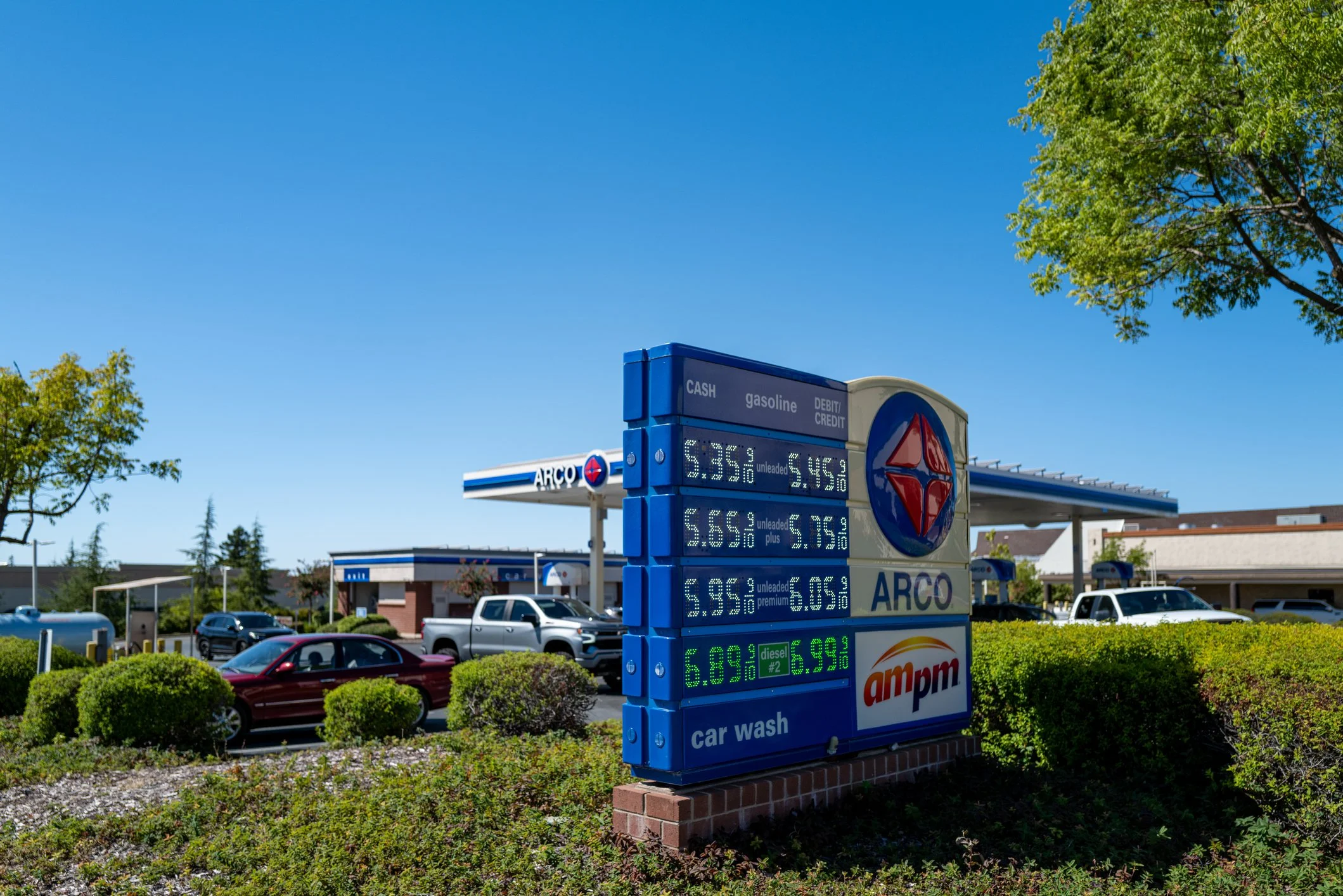
Auburn, CA, United States - August 29, 2026: An ARCO gas station and ampm price marquee showing elevated diesel and fuel prices.
Photo credit: Chris Allan
Record Production. Record Shortage.
Americans have heard it for a decade: the United States produces more oil than any nation in history. That’s true. So how can the world's largest producer be running short of diesel?
Because crude oil is not one thing. The shale revolution gave America an ocean of light, sweet crude. It is excellent for gasoline and naphtha. It yields comparatively little diesel.
America's refineries were not built for it. Long before shale, refiners invested heavily to run the heavier, higher-sulfur crude that dominated global supply. Today, nearly 70 percent of US refining capacity runs most efficiently on heavier crude, which is why 90 percent of our crude imports are heavier than what we pump at home. The coking and hydrocracking units that turn the bottom of the barrel into distillate make up about 29 percent of US capacity, and they have to be fed heavy crude that the United States does not produce.
So the country does something that sounds absurd until you understand it. We export our light oil and import heavy oil to complete the blend. Canada normally sends about 4 million barrels a day of heavy crude south, and when oil sands maintenance cut roughly 300,000 barrels a day this month, American refiners felt it immediately.
On the East Coast, the problem is starker still. The region's refining capacity fell by half over the last decade, and around 84 percent of its distillate supply now comes from outside the region, by pipeline from the Gulf Coast or by tanker from abroad. New York Harbor remains dependent on imported diesel because it lacks the refining capacity to make its own.
Energy independence measured in barrels is a statistic. Measured in diesel, it is a vulnerability.
The war didn’t break the system. It found the cracks.
The immediate causes of this crisis are no mystery. Since late February, the closure of the Strait of Hormuz has disrupted roughly a fifth of the world's oil supply. Russia, the world's second-largest diesel exporter, banned diesel exports in July after Ukrainian drones hit several of its refineries. Global refinery runs in August were more than 6 million barrels a day below the prior year, and global diesel exports fell 25 percent, just as harvest and heating season arrived.
The fragility was always there; the war simply revealed it.
For years before the first missile, the West was closing refineries, not building them. LyondellBasell permanently shut its 263,776-barrel-per-day Houston refinery, and Phillips 66 moved to close its Los Angeles refinery. Every closure made sense to a spreadsheet built on the assumption that fuel demand would fade on schedule. Demand did not fade. The capacity simply left.
So when the shock came, nobody had any to spare. S&P Global's Karim Fawaz put it plainly: "Inventories are low, spare refining capacity is scarce."
The global refining system runs on crude blends sourced from a handful of regions and moved through a handful of chokepoints. That’s a single point of failure with a very long fuse.
Next-generation refining starts with a different barrel.
Refining is fractionation. You take a complex hydrocarbon and separate it into the molecules the market wants. The science is more than a century old. What has never changed is the feedstock.
FASForm™ applies the same fractionation science to coal. The process disassembles it at the molecular level, in a closed-loop process, into six products: ultra-low sulfur diesel, jet fuel, naphtha, FASCarbon™, sulfuric acid and ammonium sulfate fertilizer. The refining industry measures itself against the 3-2-1 crack: three barrels of crude yielding two barrels of gasoline and one barrel of distillate. FASForm works on a different equation entirely. One feedstock produces six products, and every one of them is a globally traded commodity with deep, liquid markets.
We are not here to replace the refinery. We are here to add the supply the current system cannot produce: diesel made from a feedstock that is domestic, abundant, does not need a heavy crude blend, and never passes through anyone's strait.
Diesel is diesel. Ultra-low sulfur diesel from Mason County meets the same specification, trades in the same markets and moves on the same logistics as any other. Once constructed, our site will sit on the Ohio River, with barge access down the Mississippi to the Gulf, the same arteries that already carry America's refined products to the world. We plan to plug into the global commodity trade. We simply start from a different barrel.
That is what energy resilience means. It is not rationing, and it is not a strategic reserve drawn down in a crisis and refilled at a premium. It is new molecules, made from a resource the United States holds in greater abundance than any nation on earth.
From one plant to a platform.
On April 2, we broke ground in Mason County, West Virginia. On September 24, we announced the next step: we selected Kiewit Engineering Group, a subsidiary of Kiewit Corporation, to perform front-end engineering and design for the plant, and that work has begun.
The significance of that choice is hard to overstate. Kiewit traces its roots to 1884. It is employee-owned, reported $18.2 billion in revenue last year, and employs 34,500 staff and craft professionals. It works across power, industrial, and oil, gas and chemical markets. Its FEED work with us is being done on an open book, with the builder developing the cost basis alongside the design and working toward a lump-sum proposal for the facility. That is how serious industrial projects remove risk before the steel goes up.
Our board was directly involved in the decision, including Jean Abiassi, who spent seventeen years at Kiewit as a field engineer, chief engineer, lead estimator and project manager. And the technology remains ours. Joe Witherspoon directs the process design. As Joe put it, "FASForm is our technology, and it stays that way." Kiewit brings the engineering, constructability and cost discipline that surround it.
The plant is scheduled to be run by Bob Portz, a Charleston native who has spent more than thirty years inside American refineries, from Ashland to Marathon Oil to Hunt Refining to Sinclair to PBF Energy's Toledo refinery. He helped build Wyoming Renewable Diesel under Sinclair.

"I've spent thirty years watching refiners chase diesel yield out of whatever crude they could get. When the crude blend is wrong or the ship doesn't come, the diesel doesn't get made. What drew me to FASForm is that it doesn't depend on that blend at all."
— Robert Portz, Vice President, Operations & Engineering
That is the difference between an idea and an industrial company: refinery people and one of North America's premier engineering organizations building a refinery-grade process.
Mason County will be the first installation, not the last.
On September 1, we signed a memorandum of understanding (“MOU”) with Western Fuels to jointly develop a mine-mouth FASForm facility at the Dry Fork Mine near Gillette, Wyoming, in the heart of the Powder River Basin. Wyoming is the nation's largest coal-producing state. The MOU sets the framework for long-term agreements covering a site lease, a coal supply of up to roughly 2.7 million tons a year initially and 5.4 million at full build-out, and Western Fuels' purchase of ultra-low sulfur diesel from the facility for its mining, haul and member operations.
Think about what that means. A mine that runs its haul trucks on diesel would buy diesel made from its own coal. The feedstock never leaves the property. As our Chief Commercial Officer, Andrea Moran, described it, there is "no rail, no barge, no distance between the coal and the finished fuels." And Dry Fork sits inside the Gillette generation cluster, where more than 1,200 megawatts of coal-fired capacity operate within a few miles of the mine. That is FASGEN™ territory.
On September 9, we signed a letter of intent with Cora Terminal, a joint venture of Watco and SCH Services, for a multi-phase FASForm deployment at its terminal on the Mississippi River in Rockwood, Illinois. Cora offers year-round river access, unit-train rail capacity, bulk handling and Illinois Basin coal in one place. The contemplated structure starts with roughly 85 acres for a plant designed to process 7,500 tons of coal a day, with room to expand to about 130 acres for a second plant. Cora would handle the rail, barge and transloading. We would build and operate the plants.
Three sites. Three of America's great coal basins: Appalachia, the Illinois Basin and the Powder River Basin. Two of the nation's great rivers. That is the beginning of distributed refining capacity across the American interior.
And the platform extends further. More than 200 existing coal-fired plants across this country already have rail, water, grid connections and permitted industrial land. FASGEN plans to co-locate FASForm at those sites, placing new fuel production exactly where the feedstock already arrives, on infrastructure that has already been paid for.
This is not only an American problem. Our patent portfolio spans nine countries on five continents, covering the nations that produce the large majority of the world's coal. Many of them sit on enormous reserves while importing their fuel through the same chokepoints now squeezing them. The resilience we are building in America is exportable.
We wrote it down before it happened
In June, in "The Scoreboard," I reviewed the calls we made years ago on ESG and energy demand. This crisis is testing a different set: the calls we made this spring on supply security. They are public and dated.
On March 31, in "Antifragile," I argued that the Hormuz closure had exposed the global energy system as fundamentally fragile, and that value would shift toward domestic feedstock and diversified outputs. On April 7, we framed Mason County as a platform built to decouple energy production from global chokepoints. On April 30, in "The Wrong Switch," I warned that converting coal plants to natural gas trades resilience for dependency. On May 6, we explained that FASForm™ was engineered from the start for commercial deployment, not as a lab experiment hoping to survive scale. On May 11, we traced the fertilizer shock straight to the American farm. Diesel is the second bill landing on that same farm.
Since the original FAS business plan, we have run every major question through one framework: Science, Technology, Economics, Politics. The Science of fractionation is settled. The Technology is patented and engineered for scale. The Economics favor a feedstock that is domestic, abundant and outside the chokepoints. And Politics, the last pillar to turn, has turned. When all four line up, you don't have to predict the headline. You only have to be standing in the right place when it arrives.
The fuel that moves everything
Every energy crisis asks the same question: who can make more?
For six months, the answer has been nobody. Refiners are running flat out. Spare capacity is gone. The heavy crude our refineries need comes from someone else's oil sands or someone else's coast. A new conventional refinery is a decade away, if anyone is willing to build one at all.
We broke ground on a different answer in April. We are engineering it now. The world is going to need more fuel than the old barrel can give it, and we intend to make it.
Abundant, affordable, available energy for all.